
|
|
home | artists | artworks | bookstore | features | guestbook | about us |
|
Dorothea Tanning (1910-2012)
Table of Contents
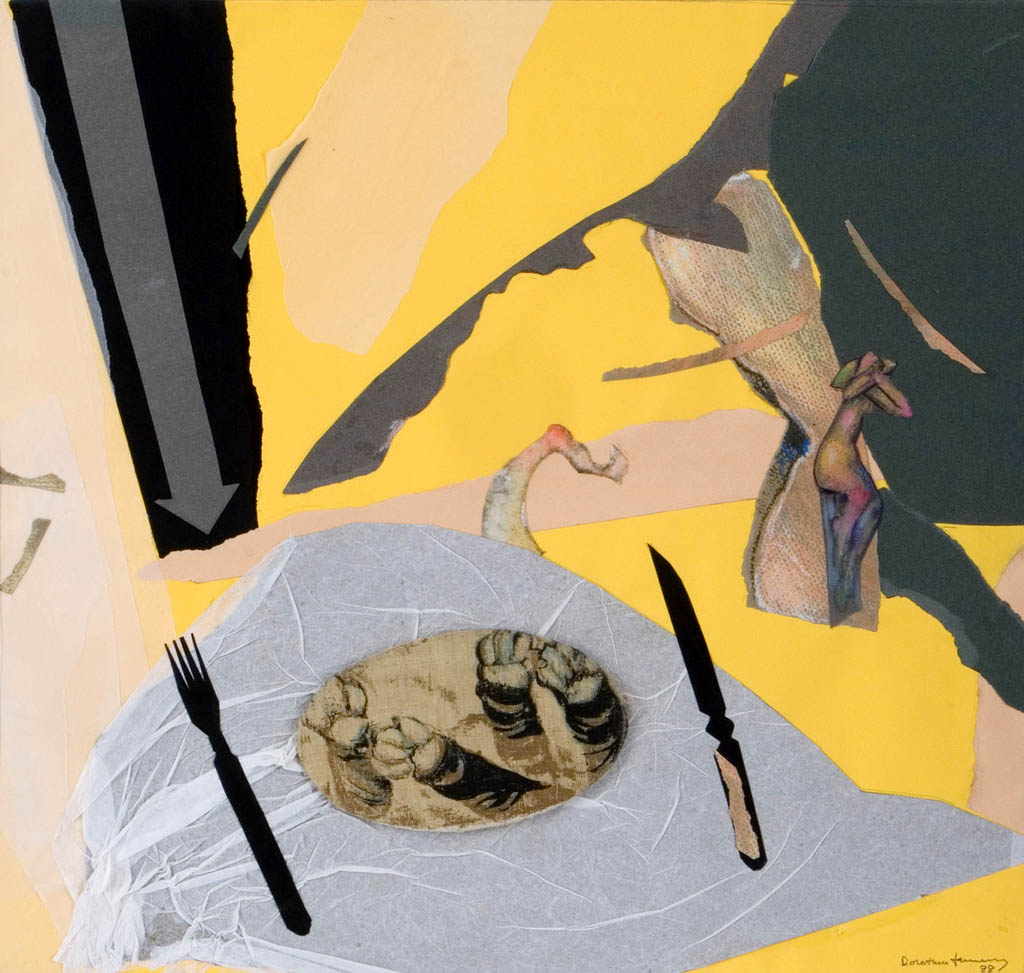
Tanning had made paintings of dining tables before, while living with Max Ernst in France in the 1950s, in what might be called a magic surrealist style. People already appear at different scales, failing to engage with one another; the most animated creature is the dog. The Table of Contents of 1988 operates more like a cubist collage, in which fragments of inner and outer worlds are brought together, asking us to think about their relationships. The table setting is both familiar, domestic, and unsettling, hinting at violence. As a still life, it freezes a specific moment in such a way that we cannot help but ask what came before, and what will follow. In 2004, Tanning published a poem called A Table of Content which makes explicit the difficulty of bringing contents together, as well as the fecundity of doing so. It describes two tables, one hers (its contents part artistically arranged and aiming to please, part in disrespectful disarray), one his (a classroom table of multiplication when the class is adjourned and anything seems possible, desirable). It focuses on the moment their contents might coincide. "Why wait?" reads the penultimate line, before the final injunction: Wait .. Tanning describes the table with its contents as a tablemap. It presents for us a condition of provisional containment, of contingent contentment, and of connection, expected and unexpected. There is a vulnerability to it, a sense of power at play. Tables can be laid in a familiar way. They can also be cleared, turned, re-arranged. --- The Table of Contents - A Reflection on Editorial Work, Suzanne Ewing & Diana Periton, pp.7-24, published online: 30 Apr 2025 |
 enlarge in new window
|
|
Gallery of Surrealism 160 Bleecker Street, #10ME, New York, NY 10012 tel 212.227.9322 info@surrealism.gallery Copyright © Gallery of Surrealism. All rights reserved. All images copyright of the artist. All text, descriptions, and images on this site are copyrighted and may not be reproduced or distributed in any way without express written permission. The availability and price of all items illustrated and/or listed on this site are subject to change without notice. |